Student FAQ
FAQs about General Education (Gen Ed 2.1) – Effective Fall 2026
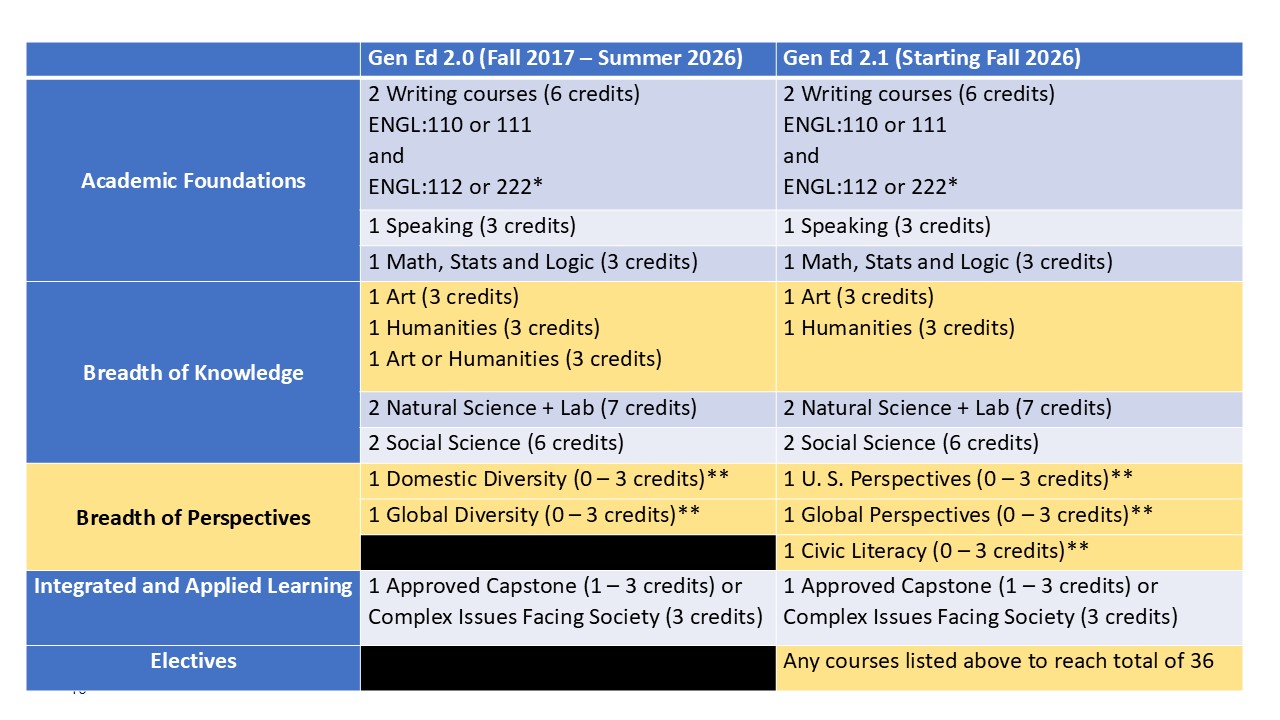
The table below shows the changes from Gen Ed 2.0 (for those entering prior to Fall 2026) and Gen Ed 2.1 (for those entering starting in Fall 2026).
*Changes are noted in Gold.
All students enrolling for the first time in Fall 2026 or after will automatically follow Gen Ed 2.1.
Yes. Any student who is currently enrolled and will graduate after Summer 2026 may choose to switch to Gen Ed 2.1.
Yes. Any student who is currently enrolled and will graduate Spring 2030 or later must switch to Gen Ed 2.1.
Contact your advisor to switch to Gen Ed 2.1.
Contact your advisor to switch to Gen Ed 2.1.
No. Students must complete all requirements of the Gen Ed version in which they are enrolled. They cannot pick and choose requirements from both programs. For example:
- A currently enrolled student scheduled to graduate prior to Spring 2030 who opts to switch to the new Gen Ed 2.1 must complete Civic Literacy as it is a requirement for the new Gen Ed.
- A currently enrolled student who stays in Gen Ed 2.0 must still complete three Arts and Humanities courses.
- Domestic Diversity courses are now classified as U.S. Perspectives
- Global Diversity courses are now classified as Global Perspectives
- Any courses taken under the previous categories will fulfill the updated requirements.
Yes. Students are required to complete a minimum of 36 credit hours of General Education coursework. If a student’s required Gen Ed courses total fewer than 36 hours, they must take additional Gen Ed electives from any approved category to meet the minimum credit‑hour requirement.
All Gen Ed 2.1 students must complete one Civic Literacy course from the following list:
- HIST 241: U.S. History & Civics to 1877
(Also counts as Social Science; does not count as U.S. Perspectives starting summer 2026) - PHIL 201: American Civics: Philosophical Foundations
(Also counts as Humanities) - POLIT 101: American Government & Civic Literacy
(Also counts as Social Science) - SOCIO 150: Civics in Society: The American Experiment
(Also counts as Social Science)
Students who completed HIST 250: U.S. History to 1877 or POLIT 100: U.S. Government and Politics before Summer 2026 are evaluated based on when the course was taken:
- If the course was taken in Fall 2025 or Spring 2026, the student will receive credit for the Civic Literacy requirement.
- If the course was taken prior to Fall 2025, the course does not satisfy the Civic Literacy requirement, and the student must complete a different approved Civic Literacy course.
- Some exceptions can be made for students that have taken a previous courses who are graduating no later that Fall 2029. Please contact Katie Cerrone, General Education Coordinator, at kc24@uakron.edu for more information.
Yes. The following combinations are illegal repeats:
- Students who passed HIST 250: U.S. History to 1877 may not take HIST 241: U.S. History & Civics to 1877.
- Students who passed POLIT 100: U.S. Government and Politics may not take POLIT 101: American Government & Civic Literacy.
- If either course was taken prior to Fall 2025, the course does not satisfy the Civic Literacy requirement, and the student must complete a different approved Civic Literacy course.
Students who received a grade “C-”, “D+”, “D”, “D-”, or “F”, “CR”, “NCR”, or “AUD” in:
- HIST 250: U.S. History to 1877 may take HIST 241: U.S. History & Civics to 1877 for a change of grade.
- POLIT 100: U.S. Government and Politics may take POLIT 101: American Government & Civic Literacy for a change of grade.
The ODHE Chancellor has not approved any AP courses or exams as meeting the Civic Literacy requirement.
Exceptions can be made for students graduating no later that Fall 2029. Please contact Katie Cerrone, General Education Coordinator, at kc24@uakron.edu for more information.
AP exam credit is awarded as follows (with a score of 3 or higher):
- AP U.S. History - Gen Ed credit for Social Science, U.S. Perspectives, and HIST 251: United States History Since 1877 (6 credits).
- AP U.S. Government & Politics - Gen Ed credit for Social Science (3 credits).
General FAQs
You should work with your advisor to choose courses that meet your interests as well as the requirements of your major. Some majors require particular quantitative reasoning, natural science, or social sciences courses.
Yes, you can “double-dip” by taking a course that meet both Breadth of Knowledge and Breadth of Perspectives requirements. For example:
- All Civic Literacy courses also meet the Social Science or Humanities requirement.
- Several Arts and Humanities courses also meet the Global Perspectives requirement.
- Several Social Science courses also meet the Domestic Perspectives requirement.
- Check the bulletin or Stellic to identify which courses meet two requirements.
You can keep track of your progress in Stellic.
Yes, you can make yourself more distinctive by focusing your Breadth of Knowledge and Breadth of Perspectives coursework in one department.
Yes. Find out what courses your AP, IB and other alternative credit options count for here.
Talk with your advisor about your transfer coursework.
Military training and coursework can be evaluated through the Transfer and Adult Student Enrollment Center. Please request that your JointServices Transcript be submitted to The University of Akron through the following link: https://jst.doded.mil. If you have any questions about your Joint Services transcript, please contact transfer@uakron.edu. Talk with your advisor for more information.
Yes, all general education courses count toward your GPA.
Yes, Global Perspectives requirements may be met through study abroad or military deployment. Contact the General Education Coordinator (kc24@uakron.edu) to find out what documentation is required.
Students who have completed an Associate of Arts or Associate of Science degree with an identifiable Ohio Transfer Module (OT36) will receive credit for the UA OT36 (Academic Foundations and Breadth of Knowledge).
For degrees from institutions other than Ohio public institutions, the Coordinator will evaluate.
Students who have completed the Ohio Transfer Module (OT36) at another institution will receive credit for the UA OT36 (Academic Foundations and Breadth of Knowledge). Students must complete any Breadth of Perspectives and Integrated and Applied Learning requirements that have not already been met with transfer work.
For degrees from institutions other than Ohio public institutions, the Coordinator will evaluate.