Statistics, BS
Earn two degrees in five years
Earn your bachelor's and master's degrees in statistics in just five years. Choose any of UA's three Statistics B.S. pathways and count nine graduate credits toward both degrees, saving time and money while advancing your expertise.

Program Details
- Location
- Akron Campus
- Level
- undergraduate
- Academic Pathway
- major
- Degree/Program Type
- Bachelor of Science
- Format
- In-person
- Course Info
- Curriculum Guide
- College
- Buchtel College of Arts & Sciences (BCAS)
- School/Department
- Department of Statistics
Program Contact
- Dr. Nao Mimoto
-
Interim Chair / Associate Professor / Actuarial Science Program Coordinator / Undergraduate & Graduate Academic Advisor
330.972.8011
Overview
Statistics is about more than numbers. It is about using data to understand problems, identify patterns and make informed decisions.
The B.S. in Statistics at The University of Akron builds a strong foundation in statistical theory, data analysis, computing and applied problem-solving. You'll gain hands-on experience with real data and learn to use industry-standard software and programming tools to solve complex problems in a variety of settings.
From regression to machine learning and statistical consulting, your skills can be applied across fields including business, industry, government, health and medical research, or provide a foundation for graduate study in statistics and related disciplines.
What You'll Learn
- Applications of the techniques of regression and multifactor analysis of variance
- Introductory programming for data-intensive applications including data collection, analysis, visualization
- Data organization and structures, design of statistical data bases, statistical software analysis, importing and exporting data between software
Admissions Requirements
Students must meet the general admission requirements of The University of Akron.
Career Outcomes
A degree in statistics opens the door to one of today’s most in-demand career paths. Graduates of the B.S. in Statistics program are prepared to step into these opportunities with confidence. Through a blend of theoretical coursework, modern software training, and real-world problem-solving experience, students learn how to turn data into actionable insights that help organizations forecast trends, plan strategically, and solve real-world problems. Whether entering the workforce or pursuing graduate study, our students leave equipped to lead in a data-driven world.
Additional Program Information
Required Courses
General Education Requirements
Statistics Core
Analytic Geometric-Calculus I/II/III, Programming for Data Science or Computer Science I, Theoretical Statistics I/II, Applied Statistics or Introductory Statistics I/II, Applied Regression and ANOVA, Statistical Data Management, Statistical Consulting
Statistics Electives
Build skills to make sense of data
Develop the statistical, computing and problem-solving skills to work with complex data, uncover meaningful patterns and apply what you learn to real-world questions.
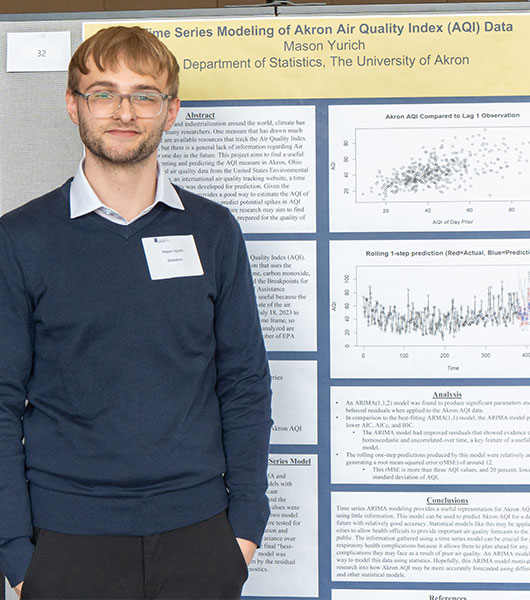

STATISTICAL METHODS
Analyze complex data
Build a strong foundation in statistical methods, including regression and multifactor analysis of variance. Learn to analyze data, identify relationships and use statistical evidence to better understand complex questions.

HANDS-ON EXPERIENCE
Put statistics to work
Apply statistical theories and concepts to real-world problems through UA's Center for Statistical Consulting. You can also explore opportunities through the DATA+ Institute, which connects data, analytics, AI and emerging technologies with hands-on learning, research and collaboration.

COMPUTING + DATA
Work confidently with data
Develop programming skills for data-intensive applications, including data collection, analysis and visualization. Learn how to organize and manage data, use statistical software and move data between software tools.
Where can a Statistics B.S. take you?
A background in statistics can lead to careers that use data to solve problems, identify trends, assess risk and inform decisions across a variety of industries.
What They Do
Create programs and algorithms that enable machines to take actions without being directed. Provide computers with the ability to learn automatically and improve from experience, without being programmed.
What They Do
Identify and analyze the areas of potential risk threatening the assets, earning capacity or success of organizations in the industrial, commercial or public sector. Predict change and future trends, as well as forecast cost to organizations.
What They Do
Use mathematical methods to help organizations develop better systems and operational procedures. Examine an organization's operations and use mathematical modelling, simulation, optimization, data science and other analytical approaches to find more effective ways of working. The organization is then able to use the information to develop a strategic policy and make better decisions.
What They Do
Design and manage experiments and surveys and deal with the initial collection of data. Process and analyze the data in context, looking for patterns to help make decisions, then advise on findings and recommend strategy.
Experience statistics beyond the classroom
Connect with other students, get involved and see how Akron graduates are putting their degrees to work.
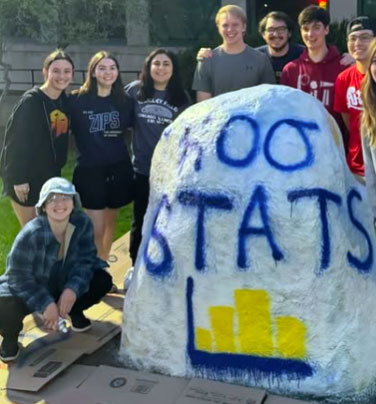
Find your community with RooStats
Connect with fellow students through RooStats, UA's Statistics Club. Get involved with a student organization centered around a shared interest in statistics and data.
Why study statistics?
Hear from an Akron Statistics student about what drew him to the field and how he sees statistics connecting data, problem-solving and decision-making.

Be the person who explains what the numbers mean
Statistics student Bo Barrel was drawn to the field because of its flexibility and broad applications. For him, studying statistics meant learning how to work with data and, just as importantly, explain what the numbers mean so others can use that information to make decisions.