Statistics - Data Science, BS
Earn two degrees in five years
Earn your bachelor's and master's degrees in statistics in just five years. Choose any of UA's three Statistics B.S. pathways and count nine graduate credits toward both degrees, saving time and money while advancing your expertise.

Program Details
- Location
- Akron Campus
- Level
- undergraduate
- Academic Pathway
- major
- Degree/Program Type
- Bachelor of Science
- Format
- In-person
- Course Info
- Course Info - Statistics Data Science BS
- College
- Buchtel College of Arts & Sciences (BCAS)
- School/Department
- Department of Statistics
Program Contact
- Dr. Nao Mimoto
-
Interim Chair / Associate Professor / Actuarial Science Program Coordinator / Undergraduate & Graduate Academic Advisor
330.972.8011
Overview
The B.S. in Statistics – Data Science track equips students with in-demand skills to manage and analyze large-scale data. You’ll gain hands-on experience in statistical modeling, machine learning, and data mining, preparing you to solve complex problems in business, healthcare, government, and more. This program helps you transform data into insights that drive smart decision-making.
What You'll Learn
- Processing large data sets and programming for data-intensive applications
- Model diagnostics and forecasting
- Data management and mining
- Classification and regression trees
- Logistic regression and neural networks
- Methodologies for statistical learning including generalized logistic and ridge regression and hierarchical clustering
- Database design and management including data modeling, relational theory
Admissions Requirements
Students must meet the general admission requirements of The University of Akron.
Career Outcomes
Demand for data professionals is rising. The U.S. Bureau of Labor Statistics projects 36% growth in data science jobs through 2033, one of the fastest-growing career fields. Our graduates are equipped with the skills employers seek: statistical modeling, programming, forecasting, machine learning, and database management.
Additional Program Information
Required Courses
- General Education Requirements
- Statistics Core
- Analytic Geometry-Calculus I, II, and III, Programming for Data Science/Computer Science I, Theoretical Statistics I and II, Applied Statistics/Introductory Statistics I & II, Applied Regression and ANOVA, Statistical Data Management, Statistical Consulting
- Data Science Electives (Choose 4)
- Introduction to Bioinformatics, Time Series Analysis, Advanced Statistical Computing, Introduction to Machine Learning, Applied Analytics-Decision Trees, Database Management for Information Systems
- Statistics Electives
Build the skills behind data-driven decisions
Develop the programming, statistical and analytical skills to work with complex data, build predictive models and uncover insights that help solve real-world problems.
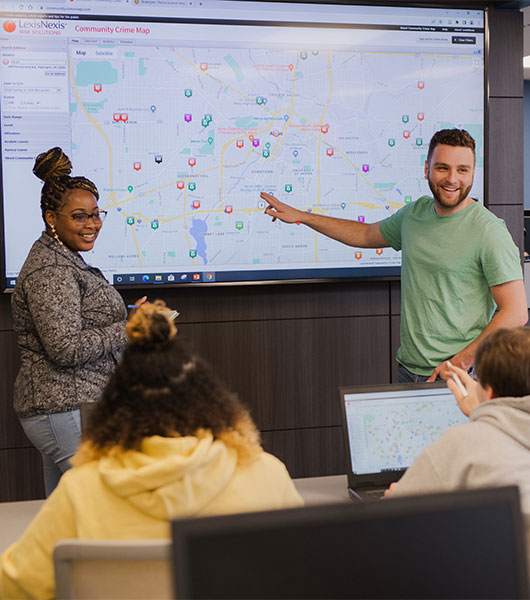

DATA + PROGRAMMING
Work with complex data
Develop programming skills for data-intensive applications while learning to process, organize and manage large data sets and databases.

HANDS-ON EXPERIENCE
Put your data skills to work
Apply what you're learning to real-world problems through UA's Center for Statistical Consulting. Explore additional opportunities through the DATA+ Institute, which connects data, analytics, AI and emerging technologies with hands-on learning, research and collaboration.

MODELING + MACHINE LEARNING
Find patterns. Make predictions.
Use statistical modeling, forecasting, data mining and machine learning techniques to identify patterns, evaluate models and turn data into useful insights.
Where can a Statistics - Data Science B.S. take you?
Data science skills are used across industries to analyze information, improve decisions, identify opportunities and solve complex problems. Explore some of the careers where you can put your statistical, programming and data skills to work.
What They Do
Collect, process, and perform statistical data analyses with the goal of helping companies make better decisions.
What They Do
Improve business processes by serving as a liaison between business and IT with a clear directive to focus on advancing strategic business objectives.
What They Do
Study information to better assist companies in making informed decisions about market opportunities.
What They Do
Create blueprints for data management systems to integrate, centralize, protect, and maintain data sources.
What They Do
Identify patterns and relationships in data to help a company predict future behaviors and make more intelligent, data-driven decisions.
What They Do
Create programs and algorithms that enable machines to take actions without being directed. Provide computers with the ability to learn automatically and improve from experience, without being programmed.
What They Do
Design, program, construct, and implement new databases, as well as modify existing databases for platform updates and changes in user needs.
Experience statistics beyond the classroom
Connect with other students, get involved and see how Akron graduates are putting their degrees to work.
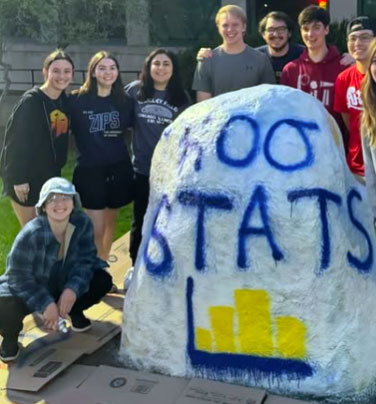
Find your community with RooStats
Connect with fellow students through RooStats, UA's Statistics Club. Get involved with a student organization centered around a shared interest in statistics and data.
See data science in action
Hear how a UA statistics student turned classroom skills into hands-on experience working with outside partners and real data.

From data to real-world solutions
Shane Vaughan gained hands-on experience working with outside partners on real statistical projects. One project involved developing a software application to help predict coffee flavor profiles based on different roasting conditions.